

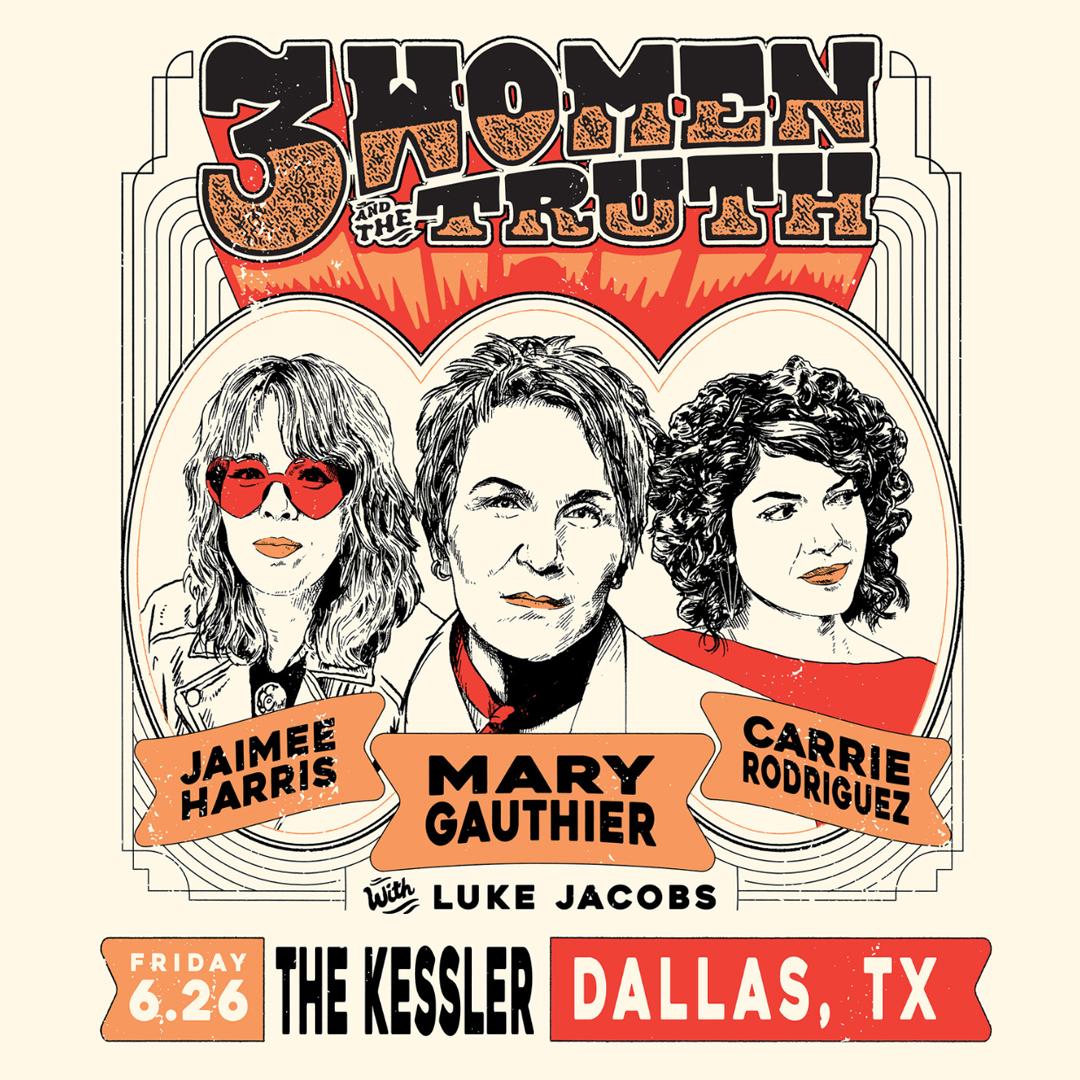
An Evening with Three Women and The Truth (feat. Mary Gauthier, Jaimee Harris, and Carrie Rodriguez)
Mary Gauthier
Mary Gauthier is a Grammy-nominated American folk singer-songwriter and author, known for songs that blend emotional resonance, depth of character, and lyrical insight. Her storytelling—raw, honest, and unwavering—has established her as one of America’s most compelling voices, offering beauty in sorrow, healing in loss, and perspectives only an artist of profound empathy can provide. Gauthier’s songs have been recorded by artists including Tim McGraw, Blake Shelton, Kathy Mattea, Boy George, Jimmy Buffett, Vince Gill, Bettye LaVette, and many more. She has received honors from the Americana Music Association, International Folk Music Awards, the Independent Music Awards, the GLAMA Awards, and the UK Americana Association. Her work has appeared extensively in film and television, including Yellowstone and ABC’s Nashville, and her memoir, Saved by a Song, was published by St. Martin’s Press.
Jaimee Harris
Jaimee Harris turned 30 during the pandemic. It’s a milestone that is a rite of passage even during normal times. But for this Texas-born singer-songwriter, it came in the midst of one of the strangest and most tumultuous periods in American history. When the world stopped during lockdown, Harris, like many others, found herself gazing back into the past, ruminating on the nature of her hometown and family origins, and reckoning with their imprint on her. The term ‘nostalgia’ derives from the Greek words nostos (return) and algos (pain), and if Harris’s Boomerang Town can be regarded as a nostalgic album, it is only nostalgic in the sense that the longing for home is a desire to return to the past and heal old wounds.
“I’m at an age where I’m wrestling with trying to understand the nature of my family,” Harris says. “There’s been suicide, suicide ideation, and there’s certainly been addiction all through my family. My dad’s father died of suicide when he was 25 and I was 5. I couldn’t imagine not having my dad right now.”
Harris’s sophomore effort, Boomerang Town marks a bold step forward for this country-folk-leaning singer-songwriter. It is an arresting, ambitious song-cycle that explores the generational arc of family, the stranglehold of addiction, and the fragile ties that bind us together as Americans.
For Harris, the album began gestating around 2016, a time of great loss for many in the Americana community, with the songwriter losing several musicians close to her. The shift in the nation’s political landscape had ushered in a new level of polarization that saw whole swaths of cultural life being demonized. For someone who grew up in a small town outside of Waco, Harris believed the values instilled in her by her parents were not entirely in line with how many on the left were viewing — and vilifying — Christians, citing them as responsible for the new change in leadership. As a person in recovery, Harris has had to re-evaluate her own connection to faith and find strength in a higher power (“Though he’s not necessarily a blue-eyed Jesus,” she laughs), though she certainly knows what it’s like to “be told how to vote” in a Southern church setting.
It was from the intersection of these social, personal, and political currents the album was born. And while much of the material on Boomerang Town was inspired by personal experience, the songs on this collection are far from autobiographical xeroxed copies. More than anything, they come from a place of emotional truth.
Boomerang Town traces the fortunes of a host of characters who live on the knife’s edge between hope and despair. The title track, whose sound recalls the best of Mary Chapin Carpenter’s ’90s work, features a young couple from a small-town working dead-end jobs who get “knocked up” and have their dreams put on hold. It is a portrait of rural desperation and the restless search for salvation against long odds. “This is what it’s like to be a part of the post- “‘Born To Run’ Generation,” Harris quips. “Springsteen’s generation had somewhere to run to. I’m not so sure mine does.” For the characters in these songs, escape isn’t always a matter of geographical distance.
“I tried a lot of perspectives [on this one],” Harris says about writing the title track. “My parents are high-school sweethearts and I was an accident and they’re still happily married. I worked at Wal-Mart when I was 19. I reflected on this guy who was the brother of a good friend of mine. He didn’t drop out. He knocked up his girlfriend and went into the military. Certainly [the song] is a combination of me and not me. It was me thinking about what might have gone differently for my parents, who are still in Waco and own a business there.”
Harris’s father, whom she counts as a big supporter and responsible for much of her musical education, took her to the first Austin City Limits Music Festival, where she had the life-changing, Eureka moment of seeing Emmylou Harris, Patty Griffin, and Buddy and Julie Miller perform on stage at the same time. It was then the young Harris knew what she had to do. She had found her ticket out.
Harris continues: “Why was I able to get out of my boomerang town? Why are others stuck there, longing to leave but unable to find their way out? Writing these songs, bringing these narrators to life, brought me closer to the answers,” she says.
Themes of grief and addiction permeate other sections of the record. “How Could You Be Gone,” which Harris wrote with her partner, the venerable folk songwriter Mary Gauthier, reflects on the passing of a close friend during the pandemic, as well as the 2017 death of Harris’s mentor and compadre Jimmy LaFave, a long-time fixture on the Americana scene who succumbed to cancer. “It’s been my experience that grief operates on its own timeline,” Harris says. “I wanted this track to build and repeat with intensity to mirror the experience of relentless grief.” Another song, “Fall (Devin’s Song),” is about a former childhood classmate of Harris’s who was accidentally shot and killed in the sixth grade. The song was inspired by a series of “In Memoriam” pieces the boy’s mother wrote to the local paper, and the song serves as a tribute to both of them, as well as a commentary on the timeless nature of grief.
One of the album’s standout tracks is the lilting, Irish-influenced “The Fair And Dark Haired Lad,” a Chicks type-number that grapples with the seductive nature of alcohol. Another tune that deals with the demon rum, “Sam’s,” is far more dirge-like, and its dark, circular melody mirrors the claustrophobia and sense of trapping that comes with the onset of addiction and mental collapse.
Boomerang Town is not entirely a lament, however, with songs like “Love is Gonna Come Again” and the wistful “Missing Someone” shining with hope in the face of the darkness. For this is a record that understands that love and grief are two sides of the same coin. It also announces the arrival of a great new songwriter on the scene.
“My goal is to just write the best possible song I can write,” Harris says, “and I wanted to have ten songs that made sense together sonically. I still believe in the album format, and I wanted to lay the groundwork as a solid songwriter.” On Boomerang Town, Jaimee Harris, who was able to find her way out — unlike so many others — has accomplished all that, and much more.
Carrie Rodriguez
“The self-proclaimed ‘half-gringa, half-Chicana fiddle[r]’ has made an album that combines seemingly disparate influences into one gloriously cohesive Spanglish statement…The seemingly improbable cultural mashups are a perfect expression of reality for many folks in Texas and beyond.” —NPR Music
“The melding of cultures can be a beautiful thing, especially when orchestrated by such a talented cast. The Sacred Hearts includes bassist Viktor Krauss and the ubiquitous guitarist Bill Frisell putting their special stamp on the material.” —Associated Press
“Rodriguez has been hinting at the ambition displayed on Lola for some time. What’s surprising is how a record of such scope and imagination can be rendered so intimately and elegantly.” —All Music
Carrie Rodriguez, a composer, violinist, and singer from Austin, Texas, finds beauty in the cross-pollination of diverse traditions. As a singer-songwriter she has released 5 solo studio albums, 3 duet albums with legendary Chip Taylor (author of “Wild Thing and “Angel of the Morning”), and 2 live albums. Her last full-length solo recording, the bilingual Lola, was heralded as “the perfect bicultural album,” and was included in NPR’s best albums of 2016 as well Rolling Stone’s Best Country albums of the year. Carrie has performed on stages across North America and Europe, as well as on programs such as PBS’ Austin City Limits, The Tonight Show, and NPR’s Tiny Desk Concerts. In 2017, Carrie founded a highly acclaimed ongoing concert series which resides at the historic Stateside at the Paramount Theatre in Austin, Texas called Laboratorio that both celebrates and explores Latinx culture and its contribution to the American experiment. Her most recent work has been as a composer/lyricist for an original musical, ¡Americano!, chronicling the true story of an inspiring DREAMer named Tony Valdovinos, which enjoyed a successful 6 week run off-broadway at New York City’s New World Stages in June of ’22, and also earned Rodriguez a nomination for a ’22 Drama Desk award for Outstanding Music.


