

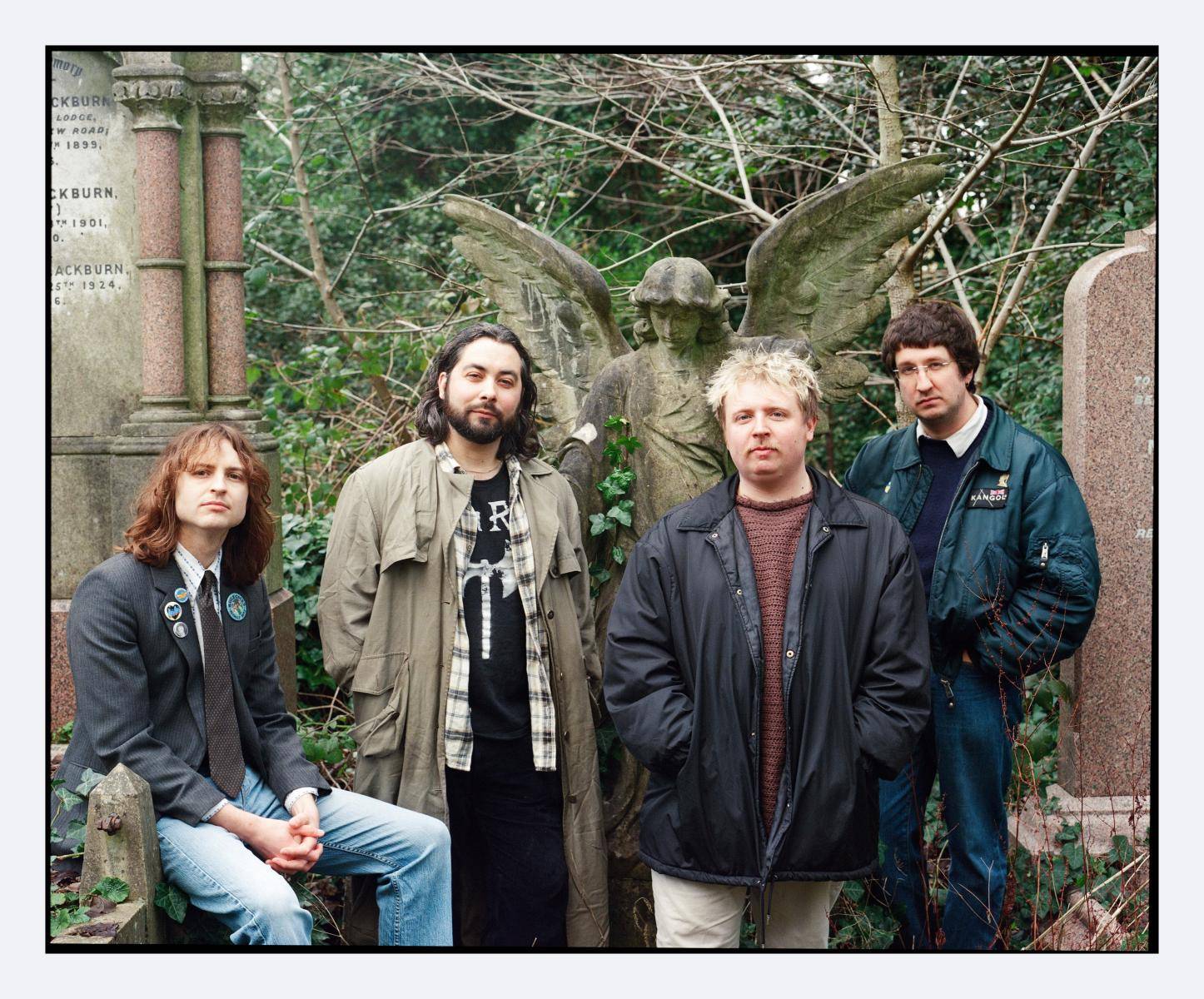
The Tubs
Upon arriving in the United States for The Tubs’ first tour of the country, frontman Owen Williams
told The New Yorker, “We’re here to unite the country. We’re gonna come, like, three times. By that
point, I think this place will start healing.” Then, joyously, they did just that, piling into a van and
criss-crossing the States, bringing their literary, bleary-eyed, world-weary, night-of-your-life
highwire act to the masses when it was needed most. Along the way, they signed to Merge
Records, who will release The Tubs’ third full-length album, Hard Life, on September 11, 2026.
The Tubs have never lacked for ambition — on Hard Life, theirs is to complicate the Tub-ullar
experience. Having perfected their sound across two albums and hundreds of shows, the London-
based Celtic jangle boyband — Williams (vocals, guitar, keyboards, bass), Dan Lucas (guitar), Taylor
Stewart (drums), and Max Warren (bass) — push themselves even further into the shimmering
heart of virtuosic indie rock. They’re joined by frequent collaborators Lan McArdle (vocals), George
Nicholls (guitar), and Rachel Kenedy (keyboards), all of whom have orbited various Tubs and Gob
Nation-adjacent efforts dating back to Joanna Gruesome, but the secret to Hard Life’s lushness is the
addition of fiddle player Chris Haigh, an instructor and session musician who left an indelible mark
on British pop on Steps’ “5, 6, 7, 8.”
Mirroring Williams' use of trilling on vocal melodies, Haigh’s fiddle shades the vocalist's rueful
croon like a bruise. On “Stoop to Me,” the folkiest, jangliest pop song on the album, Haigh’s licks
complement Williams at his most self-deprecating, the lopsided smile of a guy trying not to let on
how wounded he is in unrequited love. On album opener and title track “Hard Life,” it’s the
sweetness of the ascending fiddle lines in the mix that weds the harshness of Williams’ lyrics to The
Tubs’ fist-pumping anthemics.
The hard line Williams takes here and elsewhere on Hard Life further troubles one’s idea of a Tubs
song. The persona familiar to listeners of Cotton Crown and Dead Meat — to quote Williams, “navel
gazing about romantic abjection, London squalor, and the indignities of grief and OCD” — is still
present, but so too is a second voice, steelier and more experienced. “The second persona doesn’t
have much time for the first,” Williams explains, “often haranguing him for his self-indulgence and
immaturity; sometimes fairly, sometimes unfairly.”
It’s the scold who takes center stage on lead single “Who’s Gonna Love You Now?” His questions,
from the titular one to more concrete concerns like “Who’s gonna pay the rent?” existing in mocking
opposition to ideas like moving to the city and really starting to live. Though Williams plays the
crank, the song is a raver, guitars ringing out over an organ-brightened horizon. “It’s your life,”
Williams sings, the life chugging away beneath him sounding exceptionally keen. He wouldn’t have
much sympathy for the lovelorn Williams of “If You Don’t Love Me” — hell, his whole existence
seems like a warning that the kinds of romantic entanglements one suffers when they’re young will
end in loneliness, failure, and an inbox choked with unread Substacks.
On Hard Life, these voices argue, pester one another, merge into each other, and break apart,
sometimes over the course of a single song. They’re two sides of the same coin, people who’ve
experienced grief, disappointment, regret, and shame, emerging from the wreckage as changed
men. “I’m interested in the way sympathy and patience for someone suffering always runs out
eventually,” Williams says. “How this can be a good and liberating thing as well as a sad and brutal
thing. But mostly they’re just pop songs.” Exquisite, irresistible pop songs. Spin them until the
healing starts, then spin them again.


